French/Classic · creamy
Bechamel
Bechamel is a classic French white sauce that is made by whisking warm milk into a cooked butter-flour roux until smooth and thickened.
Quick facts
Core identity, dietary fit, and storage ranges in a scannable reference table.
| Origin | France, 17th century |
|---|---|
| Base | Whole milk |
| Primary ingredients | unsalted butter, all-purpose flour, whole milk, salt, white pepper, nutmeg |
| Flavor profile | mild, creamy, buttery, subtly savory |
| Color | Pale ivory to white |
| Consistency | Medium; smooth and pourable when warm, thickening as it cools |
| Refrigerator shelf life | 4 days |
| Freezer shelf life | 3 months |
| Vegan | No |
| Gluten-free | No |
| Dairy-free | No |
Dietary note
Recipes and labels vary
Check ingredient labels and individual dietary requirements; homemade and packaged versions can differ.
Browse sauces sharing an ingredient
How it’s made
Butter is melted and combined with flour to form a roux, which is cooked briefly to eliminate raw flour taste. Warm milk is whisked in gradually to prevent lumps. The sauce simmers until thickened, then seasoned with salt, white pepper, and nutmeg.
Bechamel recipe
Butter is melted and combined with flour to form a roux, which is cooked briefly to eliminate raw flour taste. Warm milk is whisked in gradually to prevent lumps. The sauce simmers until thickened, then seasoned with salt, white pepper, and nutmeg.
Ingredients
- 2 tablespoons unsalted butter
- 2 tablespoons all-purpose flour
- 2 cups whole milk, warmed
- 1/2 teaspoon salt
- 1/8 teaspoon white pepper
- 1/8 teaspoon ground nutmeg
Method
- Melt butter in a medium saucepan over medium heat until foamy but not browned.
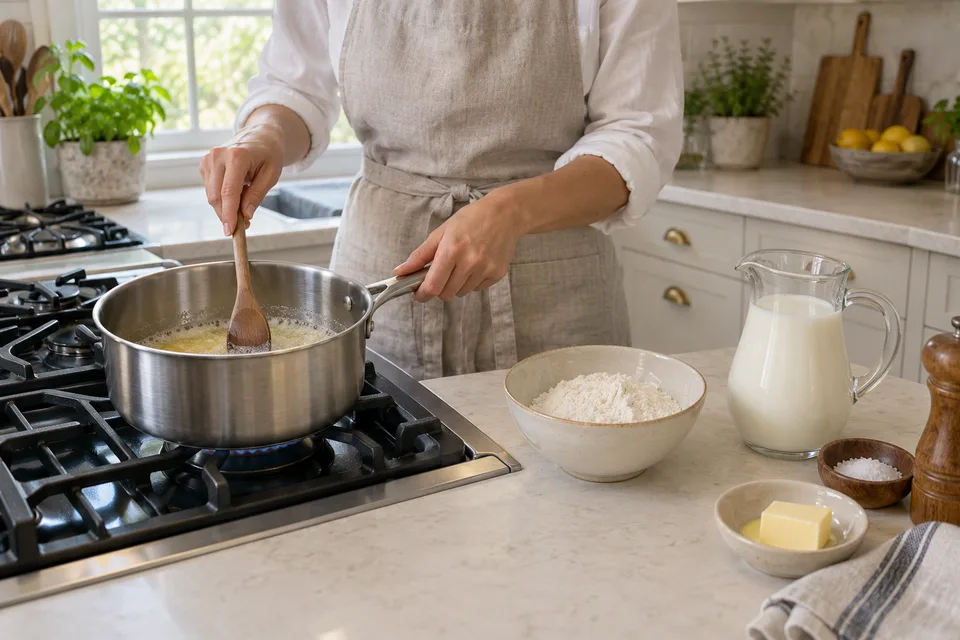
- Add flour all at once and whisk constantly for 1 to 2 minutes to form a pale roux; do not allow it to color.
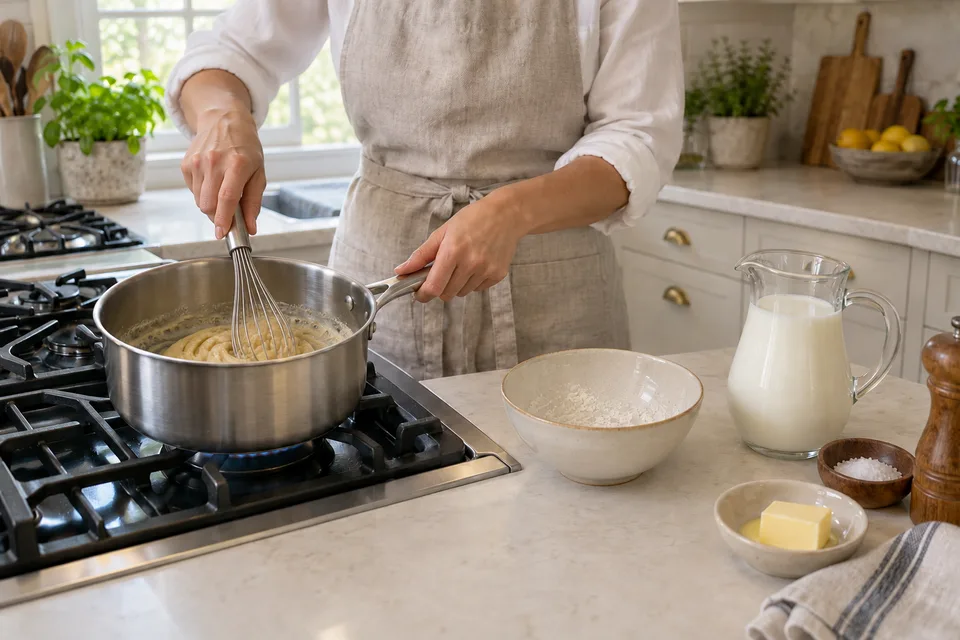
- Remove pan from heat and pour in about one-third of the warm milk, whisking vigorously until smooth.
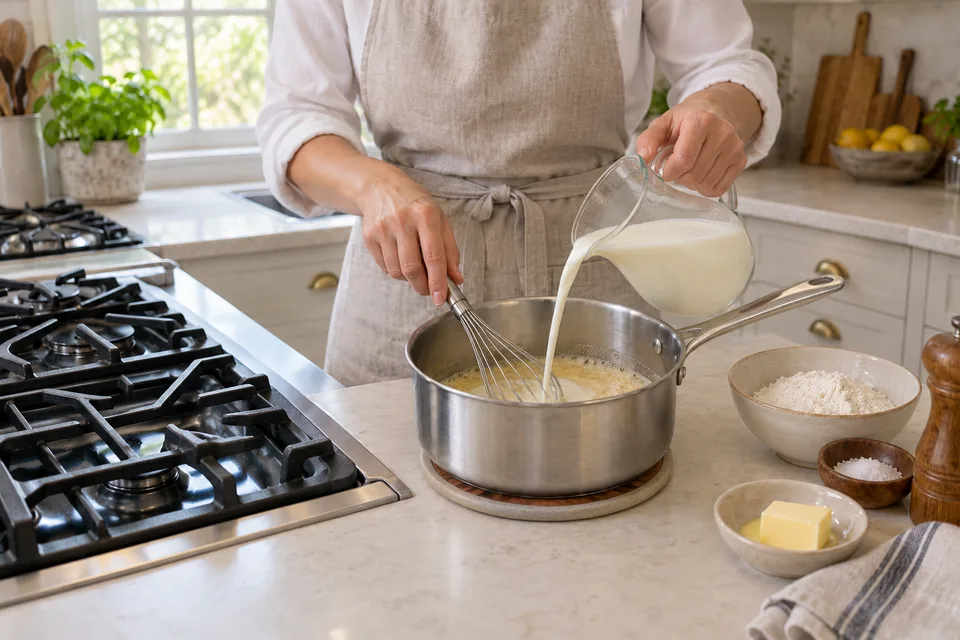
- Return pan to medium heat and add remaining milk in a steady stream, whisking continuously.
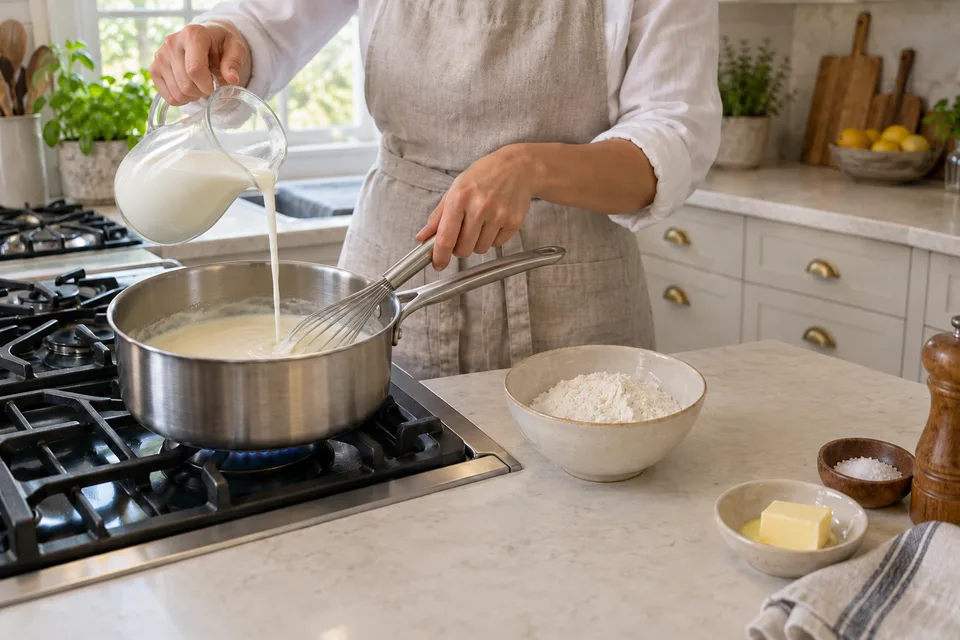
- Cook, stirring frequently, until the sauce thickens enough to coat the back of a spoon, about 8 to 10 minutes.
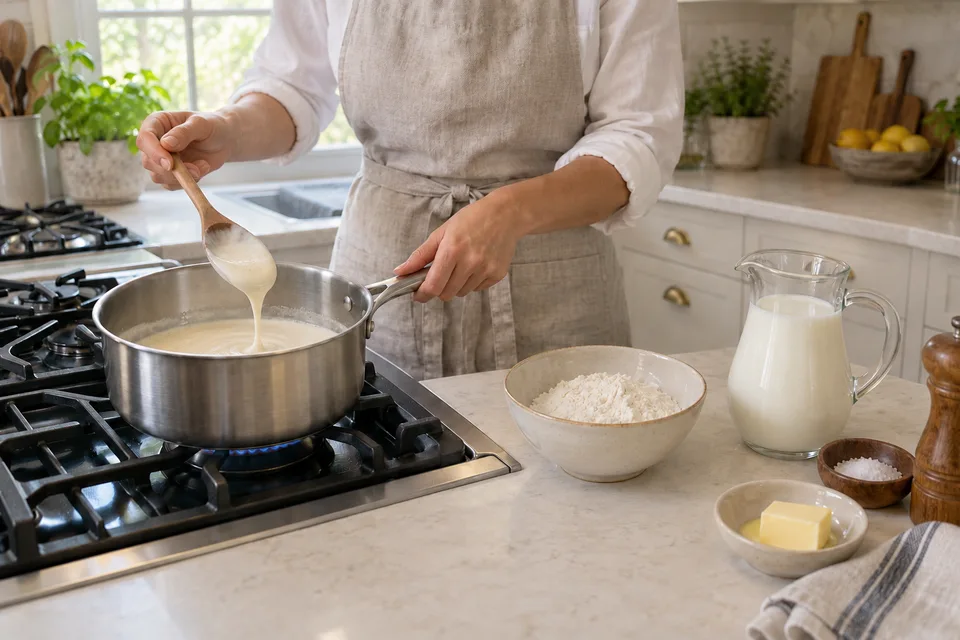
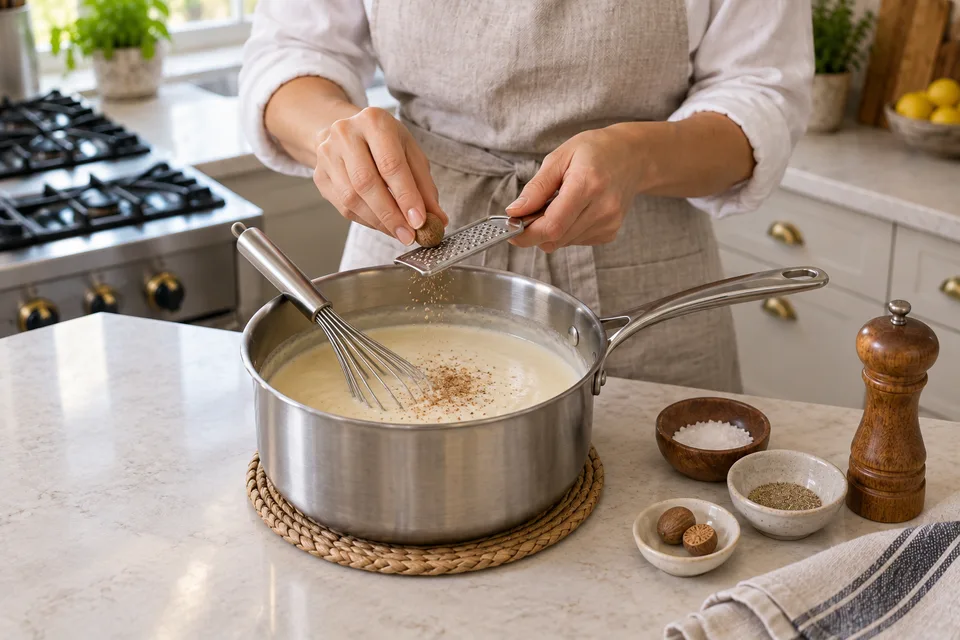
- Season with salt, white pepper, and nutmeg. Use immediately or press plastic wrap directly onto the surface to prevent a skin from forming.
Common uses
Practical applications with the role this sauce plays in each dish.
Use 01
Lasagna layer
Spread between pasta sheets to add creaminess and bind layers in classic lasagna.
Use 02
Croque monsieur topping
Spooned over ham-and-cheese sandwiches before broiling for a traditional French bistro preparation.
Use 03
Macaroni and cheese base
Used as the starting sauce for stovetop or baked macaroni and cheese when cheese is added.
Use 04
Vegetable gratin
Poured over par-cooked vegetables before baking to create a creamy, golden-topped gratin.
Use 05
Creamed spinach
Combined with cooked spinach to produce a rich, classic steakhouse-style side dish.
Use 06
Savory crepe filling base
Mixed with fillings such as ham or mushrooms to bind and enrich stuffed savory crepes.
Use 07
Pot pie filling binder
Thickens and enriches the filling of chicken or vegetable pot pies.
Use 08
Moussaka topping
Poured over layered eggplant and meat in Greek-style moussaka before baking.
Pairings
Pairing ideas grouped by food role for quick comparison.
Proteins
- roasted chicken
- baked ham
- poached eggs
- mild white fish
- turkey
Vegetables
- spinach
- cauliflower
- leeks
- asparagus
- mushrooms
- broccoli
Carbs
- pasta sheets
- elbow macaroni
- crusty bread
- crepes
- potato gratin
Bechamel substitutes
Starting ratios, best uses, and the main functional tradeoff for each alternative.
| Substitute | Ratio | Best for | Notes |
|---|---|---|---|
| Mornay sauce | 1:1 | Cheese-forward dishes | Bechamel with melted cheese added; richer and more flavorful. |
| Cream sauce | 1:1 | Pasta and gratins | Heavy cream reduced without a roux; thinner and higher in fat. |
| Dairy-free bechamel (oat or soy milk) | 1:1 | Vegan or lactose-free preparations | Swap milk and butter for plant-based equivalents; flavor is slightly different. |
| Greek yogurt thinned with broth | varies | Lighter baked dishes | Lower fat; may curdle at high heat, so add off heat. |
| Condensed cream of mushroom soup | varies | Casseroles | Convenient shortcut; adds mushroom flavor and extra sodium. |
Storage
Keep time and temperature guidance visible, and discard sauce when spoilage signs appear.
Refrigerator
Transfer to an airtight container or press plastic wrap directly onto the surface. Refrigerate for up to 4 days. Reheat gently over low heat, whisking in a splash of milk to restore consistency.
Freezer
Freeze in an airtight container for up to 3 months. Thaw overnight in the refrigerator. Whisk thoroughly while reheating over low heat, as the sauce may separate slightly.
Signs of spoilage
Discard if the sauce develops an off or sour smell, visible mold, or a grayish discoloration.
Bechamel FAQ
Short, self-contained answers to common questions.
Why does bechamel turn out lumpy?
Lumps usually form when cold milk is added too quickly to the hot roux. Add warm milk gradually while whisking constantly. If lumps do form, strain the sauce through a fine-mesh sieve and whisk vigorously over low heat to smooth it out.
Can bechamel be made ahead of time?
Yes. Make it up to 4 days in advance and refrigerate with plastic wrap pressed directly onto the surface to prevent a skin. Reheat over low heat, whisking in a small amount of warm milk to restore the original consistency.
What is the difference between bechamel and white sauce?
The terms are often used interchangeably. Bechamel is the classic French preparation using butter, flour, and milk, sometimes seasoned with nutmeg. White sauce is a broader term that may refer to any pale, milk-based sauce, including regional or simplified versions.
Is bechamel gluten-free?
Traditional bechamel is not gluten-free because it uses all-purpose wheat flour as a thickener. A gluten-free version can be made by substituting a certified gluten-free flour blend or cornstarch in the same ratio as the wheat flour.
How do I thicken bechamel that is too thin?
Continue simmering over medium-low heat, stirring frequently, until the sauce reduces to the desired consistency. Alternatively, mix softened butter and flour into a paste (beurre manie) and whisk it into the simmering sauce in small additions.