French/Classic · creamy
Bearnaise Sauce
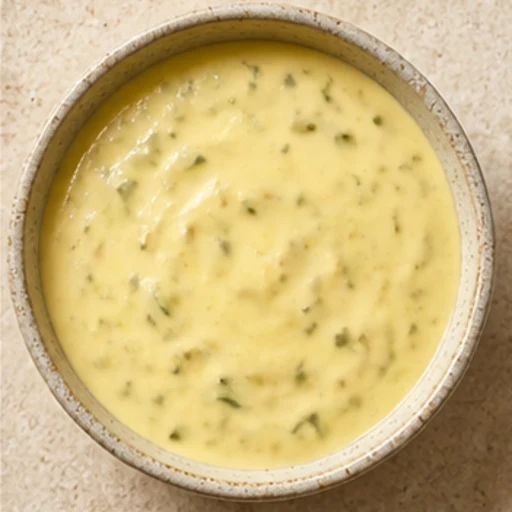
Béarnaise sauce is a French emulsified butter sauce that combines clarified butter and egg yolks with a tarragon-and-shallot reduction, yielding a rich, herbaceous condiment classically served with beef.
Quick facts
Core identity, dietary fit, and storage ranges in a scannable reference table.
| Origin | France, 19th century |
|---|---|
| Base | Clarified butter and egg yolks |
| Primary ingredients | clarified butter, pasteurized egg yolks, fresh tarragon, shallots, white wine vinegar, dry white wine, chervil |
| Flavor profile | rich, buttery, tangy, herbaceous |
| Color | pale yellow with visible green herb flecks |
| Consistency | thick; smooth, creamy emulsion that coats a spoon |
| Refrigerator shelf life | 2 days |
| Freezer shelf life | Not established |
| Vegan | No |
| Gluten-free | Yes |
| Dairy-free | No |
Dietary note
Recipes and labels vary
Check ingredient labels and individual dietary requirements; homemade and packaged versions can differ.
Browse sauces sharing an ingredient
How it’s made
Shallots, tarragon stems, white wine, and vinegar are reduced, then strained. Egg yolks are whisked over gentle heat with the reduction until ribbony. Clarified butter is streamed in slowly to form a stable emulsion, then finished with fresh tarragon and chervil.
Bearnaise Sauce recipe
Shallots, tarragon stems, white wine, and vinegar are reduced, then strained. Egg yolks are whisked over gentle heat with the reduction until ribbony. Clarified butter is streamed in slowly to form a stable emulsion, then finished with fresh tarragon and chervil.
Ingredients
- 8 oz (1 cup) clarified butter, warm
- 3 large pasteurized egg yolks
- 3 tablespoons dry white wine
- 3 tablespoons white wine vinegar
- 2 tablespoons shallot, minced
- 4 sprigs fresh tarragon stems (for reduction)
- 2 tablespoons fresh tarragon leaves, chopped (for finishing)
- 1 tablespoon fresh chervil, chopped
- 1/4 teaspoon kosher salt
- 1/8 teaspoon white pepper
Method
- Combine white wine, white wine vinegar, shallot, and tarragon stems in a small saucepan. Simmer over medium heat until reduced to about 2 tablespoons of liquid. Strain and discard solids; let the reduction cool slightly.
- Place egg yolks and the cooled reduction in a heatproof bowl set over a saucepan of barely simmering water, ensuring the bowl does not touch the water.
- Whisk the yolks and reduction constantly over the gentle heat until the mixture thickens, turns pale, and falls from the whisk in slow ribbons, about 4 to 6 minutes. Remove from heat immediately if the bowl becomes too hot.
- Whisk in the warm clarified butter a few drops at a time at first, then in a thin, steady stream, whisking continuously until a thick, creamy emulsion forms.
- Season with salt and white pepper. Fold in the chopped fresh tarragon and chervil. Serve immediately or hold warm in the bowl over the hot water, off the heat, for up to 30 minutes.
Common uses
Practical applications with the role this sauce plays in each dish.
Use 01
Steak topping
Spooned over grilled or pan-seared beef cuts such as filet mignon, ribeye, or strip steak.
Use 02
Eggs Benedict variation
Substituted for hollandaise in eggs Benedict for a tarragon-forward brunch dish.
Use 03
Roasted vegetables
Drizzled over asparagus, artichokes, or roasted root vegetables as a finishing sauce.
Use 04
Poached fish
Served alongside delicate white fish such as halibut or sole to add richness.
Use 05
Chicken accompaniment
Paired with pan-roasted or grilled chicken breast as a classic French bistro preparation.
Use 06
Dipping sauce for frites
Used as a rich dipping sauce for French fries in classic steak-frites presentations.
Use 07
Lamb dishes
Served with rack of lamb or lamb chops, where the tarragon complements the meat's flavor.
Pairings
Pairing ideas grouped by food role for quick comparison.
Proteins
- filet mignon
- ribeye steak
- strip steak
- rack of lamb
- halibut
- roasted chicken
Vegetables
- asparagus
- artichoke hearts
- roasted fingerling potatoes
- haricots verts
- leeks
Carbs
- French fries
- crusty baguette
- roasted new potatoes
- brioche toast
Bearnaise Sauce substitutes
Starting ratios, best uses, and the main functional tradeoff for each alternative.
| Substitute | Ratio | Best for | Notes |
|---|---|---|---|
| Hollandaise sauce | 1:1 | Eggs and fish dishes | Lacks tarragon flavor; add chopped fresh tarragon to approximate béarnaise character. |
| Tarragon compound butter | varies | Steak topping | Simpler to prepare; melts rather than coating as a pourable sauce. |
| Beurre blanc with tarragon | 1:1 | Fish and vegetables | Lighter body; no egg yolk, so less rich and less stable when held warm. |
| Greek yogurt with tarragon and lemon | 1:1 | Lower-fat applications | Significantly lighter; tangier profile; not a true emulsified butter sauce. |
| Mayonnaise with tarragon and white wine vinegar | 1:1 | Cold applications and dipping | Cold sauce only; suitable for sandwiches or cold beef but not as a warm finishing sauce. |
Storage
Keep time and temperature guidance visible, and discard sauce when spoilage signs appear.
Refrigerator
Transfer to an airtight container and refrigerate within 2 hours of preparation. Use within 2 days. Reheat gently over a double boiler, whisking constantly; do not microwave.
Freezer
Béarnaise sauce does not freeze well. The emulsion breaks upon thawing, resulting in a separated, greasy texture that cannot reliably be restored.
Signs of spoilage
Sour or off smell, visible mold, watery separation that cannot be re-emulsified, or any discoloration beyond pale yellow.
Bearnaise Sauce FAQ
Short, self-contained answers to common questions.
What is the difference between béarnaise sauce and hollandaise sauce?
Both are emulsified butter sauces built on egg yolks and clarified butter. Hollandaise uses a lemon juice base and has a clean, buttery flavor. Béarnaise uses a tarragon-and-shallot reduction with white wine vinegar, giving it a distinctly herbaceous, slightly tangy character.
Why does béarnaise sauce break, and how can it be fixed?
The emulsion breaks when heat is too high, butter is added too fast, or the sauce cools too much. To fix a broken sauce, whisk a fresh egg yolk with a teaspoon of warm water in a clean bowl, then slowly whisk in the broken sauce to re-emulsify it.
Can béarnaise sauce be made ahead of time?
Béarnaise is best made and served immediately. It can be held warm over a double boiler for up to 30 minutes. Refrigerated leftovers last up to 2 days but must be reheated very gently over a double boiler while whisking, as direct heat will cause the emulsion to break.
Is béarnaise sauce gluten-free?
A traditionally prepared béarnaise sauce contains no wheat-based ingredients and is generally considered gluten-free. Always verify that individual ingredients such as vinegar are certified gluten-free if serving someone with celiac disease.
What herb is essential to béarnaise sauce?
Fresh tarragon is the defining herb in béarnaise sauce. It appears twice: stems are used in the vinegar-wine reduction, and freshly chopped leaves are stirred in at the end. Chervil is a traditional secondary herb but is sometimes omitted.