Sauce technique guide
Sauce consistency guide
Sauce consistency describes how thick or thin a sauce flows and clings to food. Matching viscosity to the dish determines whether a sauce enhances or overwhelms the ingredients it accompanies.
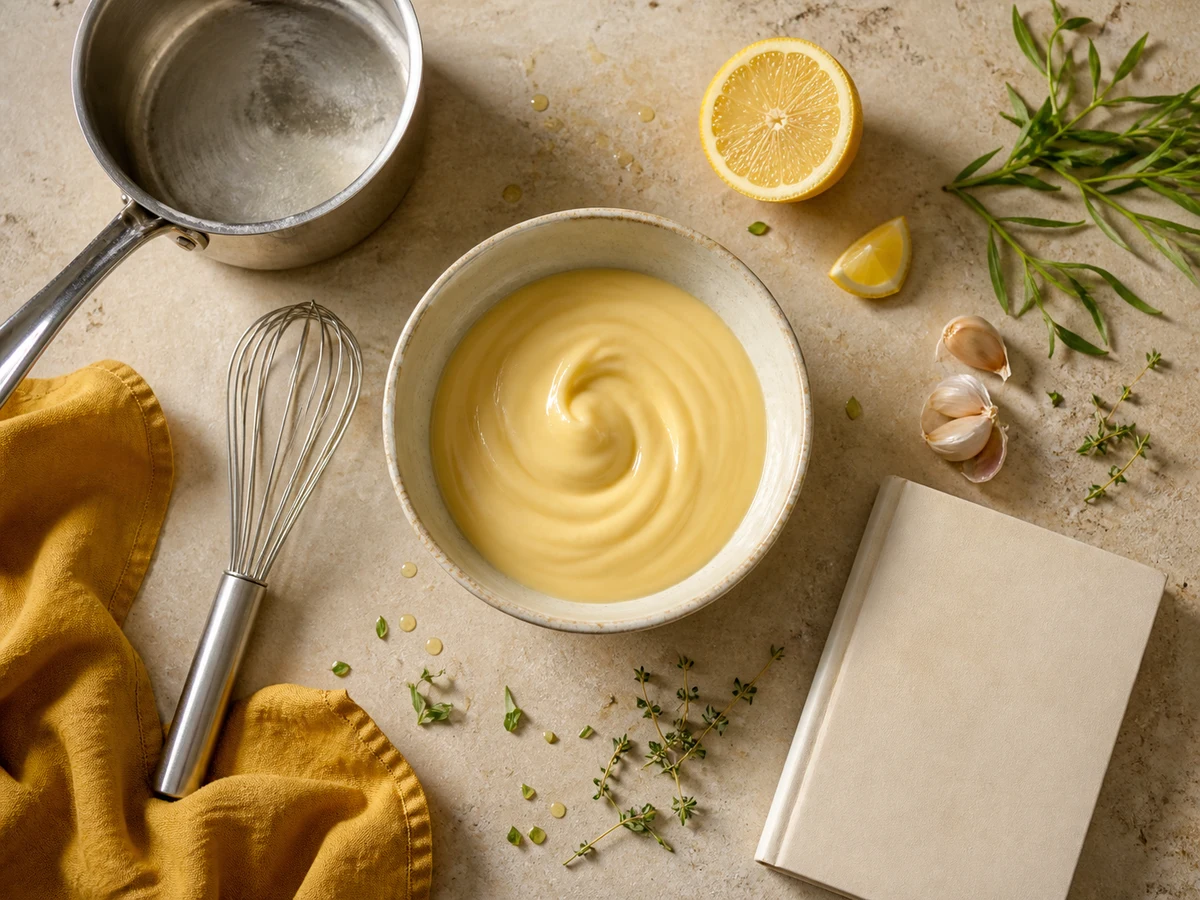
1. Understanding sauce consistency levels
Consistency is one of the primary qualities that distinguishes one sauce from another. A sauce can range from thin and pourable to thick and clingy, and the right level depends entirely on how the sauce will be used.
Thin (light) consistency
Thin sauces have a fluid, pourable texture. They suit applications where adding flavor without weight is the goal — light vinaigrettes, pan drippings, and dipping broths fall into this category. A thin sauce spreads quickly across a plate and does not cling heavily to food.
Medium consistency (nappe)
The culinary term *nappe* describes a sauce thick enough to coat the back of a spoon; the exact target still depends on the recipe and serving use. This is the benchmark consistency for many classic preparations, including béchamel, hollandaise, and cream pan sauces. Nappe represents a balance between too thin and too thick, ensuring the sauce clings to food and delivers flavor evenly.
Recipes may specify light, medium, or heavy nappe. A light nappe suits delicate fish and shellfish, adding sheen without masking the main ingredient. A heavy nappe is appropriate for hearty applications such as a cheese sauce over vegetables.
Thick consistency
Thick sauces cling firmly to food and move slowly. They are appropriate for dishes that need a sauce to stay in place — braised meat glazes, dense tomato ragù, and cheese sauces. Overcooking or excess thickening agents can push a sauce past the desired thickness into a texture that is difficult to pour or spread.
What controls consistency?
Several factors determine where a sauce lands on the thin-to-thick spectrum:
- Thickening agents — flour, cornstarch, arrowroot, egg yolks, and cream each contribute viscosity differently.
- Liquid-to-solid ratio — more liquid produces a thinner result.
- Heat and reduction — simmering evaporates water and concentrates the sauce.
- Fat content — fats affect both viscosity and the smoothness of the finished sauce.
Tip. Match consistency to purpose: light nappe for delicate fish, medium for cream sauces, heavy nappe for hearty cheese or vegetable sauces.
2. How to test consistency
Testing consistency during cooking prevents over- or under-thickening and removes guesswork from the process. Two reliable methods cover most sauce types.
The spoon test (nappe test)
Dip a wooden or metal spoon into the sauce and lift it out so the sauce coats the back. Draw a clean line down the center of the coated spoon with a fingertip. If the line stays distinct and the sauce does not immediately run back together, the sauce has reached nappe consistency. If the sauce runs back across the line, it needs further thickening. The width and stability of the line indicate whether the nappe is light, medium, or heavy.
The ribbon test
Drizzle a small amount of sauce from the spoon back into the pot. If the sauce falls in slow, thick ribbons that momentarily hold their shape before dissolving back into the sauce, it is at or near nappe. A thin sauce will fall in a fast, unbroken stream with no ribbon formation.
Practical testing tips
- Test consistency at serving temperature, not straight off high heat. Many sauces thicken as they cool, so a sauce that appears correct at a rolling simmer may be too thick once plated.
- Rely on the visual cue of the spoon test rather than a fixed cooking time. Pan size, stove output, and ambient humidity all affect how quickly a sauce reduces.
- For cream-based sauces, continuous whisking during testing helps maintain a smooth, even texture and prevents proteins from separating.
- Cornstarch-thickened sauces require heat to activate; the sauce will visibly thicken within a minute or two of adding a slurry, making it straightforward to monitor progress in real time. Avoid prolonged boiling after the sauce thickens, as overcooking cornstarch can cause it to thin out again.
Tip. Test consistency at the temperature the sauce will be served. Many sauces thicken noticeably as they cool off the heat.
3. How to fix consistency problems
Most consistency problems are correctable with targeted adjustments. The key is to make changes gradually and choose a fix that complements the existing flavor profile.
Sauce is too thin
Reduce by simmering. Simmering evaporates excess water and naturally thickens the sauce without changing its flavor. Simmer uncovered to allow liquid to escape. This is the lowest-risk method and works for most tomato, stock-based, and wine sauces. Note that reduction also concentrates salt and other strong flavors, so taste as you go.
Add a starch slurry. Mix cornstarch with cold water before adding it to the hot sauce. Combining starch with cold liquid first separates the starch granules and prevents lumps. Whisk the slurry in gradually while the sauce simmers, then let it come to a brief boil — about 30 to 60 seconds — to fully activate the starch. Cornstarch produces a clearer, glossier finish; flour adds more body but requires a longer cook time to eliminate any raw taste. Acid, sugar, agitation, and heating time can change starch behavior, so follow the tested recipe or product instructions.
Use beurre manié. Beurre manié is a paste of equal parts softened butter and flour. Small pieces are whisked directly into a simmering sauce until dissolved, providing stable thickening without a separate slurry step.
Add a purée. Blended vegetables, cooked legumes, or tomato paste can thicken a sauce while adding flavor. This approach suits rustic or vegetable-forward preparations.
Sauce is too thick
Add a matching liquid gradually. Whisk in warm liquid — stock, milk, cream, or the same base liquid used in the sauce — a small amount at a time. Using a flavor-compatible liquid preserves the sauce's taste. Plain water dilutes flavor and is generally a last resort. For pasta sauces, reserved starchy pasta cooking water thins the sauce while helping it adhere to noodles.
Warm the liquid first. Adding cold liquid to a hot sauce can cause uneven incorporation or, in egg-based sauces, curdling. Warm the thinning liquid separately before whisking it in.
Dietary and allergen considerations
When choosing a thickening method, account for dietary restrictions. Flour-based thickeners are not suitable for guests with gluten sensitivity or celiac disease; cornstarch, arrowroot, or potato starch are gluten-free alternatives. Dairy-based thinners are not appropriate for lactose-intolerant or vegan diners.
Warning. Always add thickening agents gradually. Overcorrecting is harder to reverse than undercorrecting, especially with starch-based methods.
Tip. When thinning a sauce, use a liquid that matches the sauce base — stock for savory reductions, cream or milk for cream sauces — to preserve flavor.
Sources
Primary and direct references used for current or safety-sensitive claims.
- Kitchen Vocab: Nappe – CIA Foodies — Nappe is a French term for sauce consistency that coats the back of a spoon; recipes may specify light, medium, or heavy nappe depending on use.
- The Easy Spoon Trick To Tell When Your Gravy Is Ready For Serving – Tasting Table — The spoon test for nappe consistency: sauce coats the spoon and leaves a clear line that does not run back together immediately.
- How to Thicken a Sauce That Is Too Thin: Easy Fixes for Home Cooking – Chef Dumas — A thin sauce needs more reduction, a thickening ingredient, or better emulsification; beurre manié, cornstarch slurry, purée, and pasta water are all valid fixes.
- How to Thicken Sauces with Cornstarch – America's Test Kitchen — Cornstarch usually requires only about a minute of boiling to reach full thickening potential; overcooking can cause the sauce to thin out again.
Guide FAQ
Short, self-contained answers to common technique questions.
What does nappe mean in cooking?
Nappe is a French culinary term for the consistency where a sauce is thick enough to coat the back of a spoon and hold a clean line when a finger is drawn through it. It is the standard benchmark for many classic sauces, including béchamel, hollandaise, and cream pan sauces.
How do I test if my sauce is the right consistency?
Dip a spoon into the sauce and draw a finger down the back. If a clean line stays without the sauce running back together, the sauce has reached nappe. Test at serving temperature, not at a high simmer, since many sauces thicken as they cool.
What is the best way to thicken a sauce that is too thin?
Simmering to reduce excess liquid is the lowest-risk method. For a faster fix, whisk a cornstarch slurry — equal parts cornstarch and cold water — into the simmering sauce gradually, then let it boil briefly for 30 to 60 seconds to activate the starch. Choose the method that suits the sauce's flavor profile.
How do I thin a sauce that has become too thick?
Whisk in a small amount of warm, flavor-compatible liquid — stock, cream, milk, or the sauce's base liquid — a little at a time until the desired consistency returns. Avoid plain water, which dilutes flavor. For pasta sauces, starchy pasta cooking water is an effective thinner.
Why does my sauce thicken after I take it off the heat?
Starch-thickened and dairy-based sauces continue to set as temperature drops. Proteins tighten and starches gel further during cooling. Account for this by pulling the sauce slightly before it reaches the target consistency on the stove, then checking again at serving temperature.
Can I thicken a sauce without gluten or dairy?
Yes. Cornstarch, arrowroot, and potato starch are gluten-free thickeners that work in most sauce types. Blended vegetables or cooked legumes also add body without gluten or dairy. Avoid flour-based roux or beurre manié for guests with gluten sensitivity or celiac disease.