Sauce technique guide
How to emulsify a sauce
Emulsification combines two immiscible liquids—typically oil and a water-based liquid—into a stable, uniform mixture using an emulsifying agent and mechanical force such as whisking.
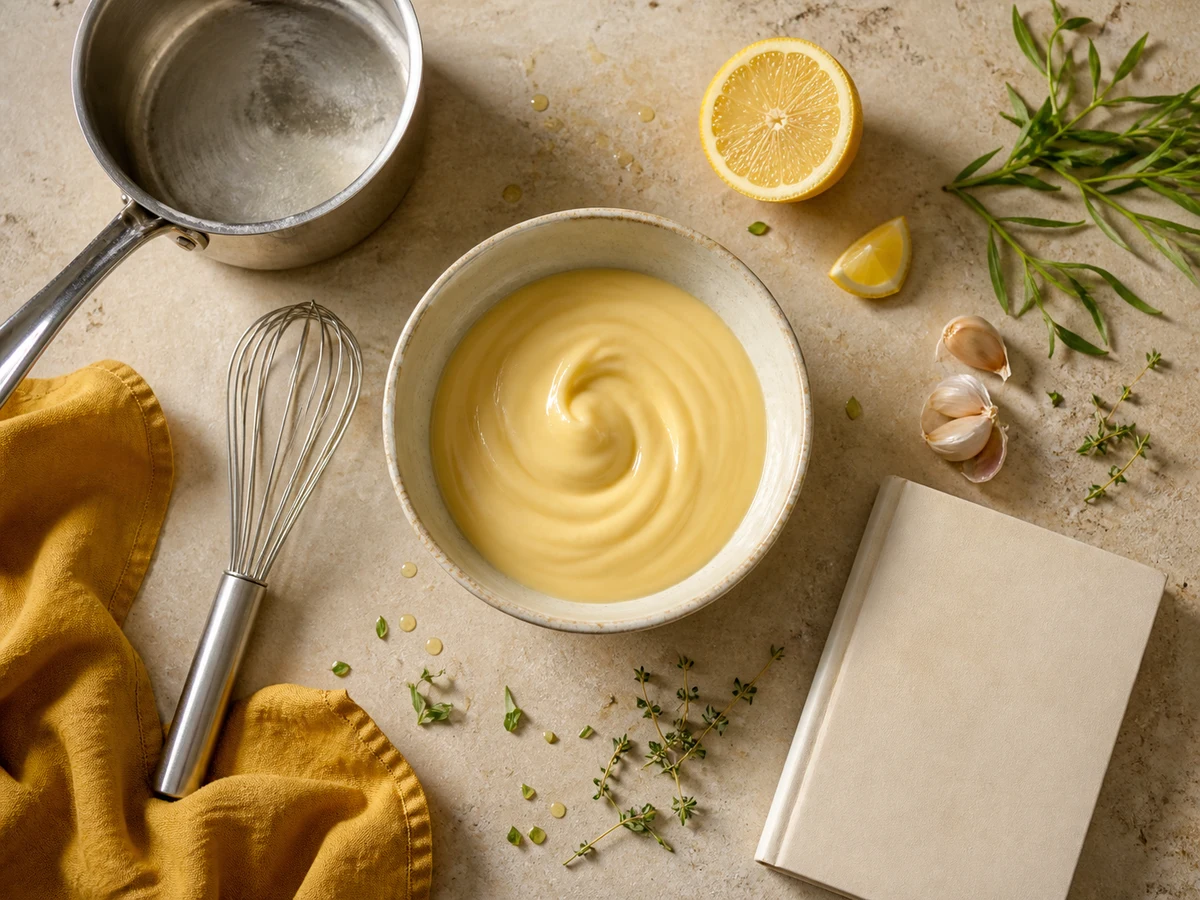
1. What Emulsification Is and Why It Matters
An emulsion is a mixture of two liquids that do not naturally dissolve into each other. In sauce-making, those two liquids are almost always a fat (oil or butter) and a water-based liquid such as vinegar, lemon juice, wine, or stock.
Left alone, fat and water separate. Emulsification forces them to combine by introducing an emulsifier—a molecule with one fat-friendly (hydrophobic) end and one water-friendly (hydrophilic) end. The emulsifier coats tiny droplets of one liquid and keeps them suspended in the other, preventing them from clumping back together.
Common culinary emulsifiers:
- Egg yolk — contains lecithin, a phospholipid that is one of the most effective natural emulsifiers. Used in hollandaise, béarnaise, mayonnaise, and aioli.
- Mustard — contains mucilage compounds that stabilize oil-in-water mixtures. Widely used in vinaigrettes.
- Butter — contains lecithin and milk proteins that allow it to emulsify into wine or stock reductions, as in beurre blanc.
- Honey and garlic paste — less potent options that can supplement other emulsifiers in dressings and pan sauces.
- Cream — itself a natural emulsion of fat dispersed in water; adding it to a fragile sauce can help stabilize the overall mixture.
The result of a successful emulsion is a sauce that coats surfaces evenly, feels smooth and creamy on the palate, and holds its texture rather than pooling into separate layers of fat and liquid. Emulsified sauces also carry and amplify flavor more effectively than their separated counterparts because fat and water molecules are held in close contact throughout the mixture.
There are two broad categories of culinary emulsions:
- Oil-in-water — fat droplets dispersed in a water-based liquid. Examples: mayonnaise, hollandaise, vinaigrette.
- Water-in-oil — water droplets dispersed in fat. Examples: butter, chocolate ganache.
A temporary emulsion (plain oil-and-vinegar shaken together) separates quickly because no emulsifier is present to hold the droplets apart at the chemical level. A stable emulsion uses an emulsifier and sustained mechanical energy to maintain the suspension indefinitely or for an extended period.
Tip. Egg yolk is the most versatile emulsifier for cooked sauces; mustard works well for cold vinaigrettes and dressings.
2. How to Emulsify a Sauce Step by Step
The core technique is the same whether making a cold vinaigrette or a warm butter sauce: combine the emulsifier with the water-based liquid first, then introduce the fat slowly while applying continuous mechanical force.
1. Start with the emulsifier and liquid base
Whisk the emulsifier (egg yolk, mustard, honey, or garlic paste) together with the water-based component (vinegar, lemon juice, wine, or stock) until fully combined. This gives the emulsifier molecules time to disperse before fat is introduced.
2. Add fat slowly
Add oil or melted butter in a thin, steady stream—drop by drop at first, then in a slow drizzle once the emulsion begins to form. Adding fat too quickly gives the oil droplets no time to disperse and wrap themselves in the emulsifier's protective layer, causing the sauce to break before it starts.
3. Whisk or blend continuously
Mechanical force—vigorous whisking, a running blender, or a food processor—breaks the fat into microscopic droplets and drives them into the water-based liquid. Smaller droplet size produces a thicker, more stable, and more flavorful sauce. A blender or immersion blender can replace hand-whisking for larger batches.
4. Control temperature
For warm emulsions such as hollandaise or beurre blanc, temperature is critical. Keep the heat gentle and consistent. Excessive heat causes egg yolk proteins to coagulate, destroying their emulsifying capacity. For beurre blanc, keep the butter cold before adding it and maintain a warm (not hot) pan while whisking quickly.
5. Maintain the correct fat-to-liquid ratio
The balance between fat and water must be maintained throughout. Too much fat relative to liquid overwhelms the emulsifier's capacity and causes separation. If the sauce thickens too much, whisk in a small amount of the base liquid to restore balance.
Machine emulsification
Blenders and food processors are standard tools for emulsified sauces made in volume. Pesto, for example, is produced by streaming oil into a running food processor, using the same principles as hand-whisking but with greater mechanical efficiency.
Warning. Never add fat all at once. A slow, steady stream is essential; rushing this step is the most common cause of a broken sauce.
Tip. For beurre blanc and hollandaise, keep butter cold before adding it and maintain gentle, steady heat throughout.
3. How to Fix a Broken Emulsion
A broken emulsion has visible fat or oil separated from its water-based phase. Stop and identify the sauce before choosing a rescue. An egg-yolk sauce, butter sauce, mayonnaise, vinaigrette, and dairy sauce do not share one guaranteed fix, and food-safety requirements still apply to any egg or dairy ingredients.
For an early break, stop adding fat and remove excessive heat. Whisk or blend a small test portion while adding a few drops of the recipe’s compatible water-based liquid. If it becomes uniform, repeat gradually with the remaining sauce. Avoid pouring in a large amount at once; both dilution and continued mechanical force affect the result.
For a fully separated sauce, a common culinary approach is to build a small fresh base that is compatible with the original recipe, then incorporate the broken sauce gradually. The fresh base might use the recipe’s emulsifier and water phase, but it should not be chosen by a universal egg-yolk or mustard rule. Follow a tested method for the exact sauce, especially when raw or lightly cooked egg is involved.
Temperature matters. Excessive heat can coagulate egg proteins or destabilize a butter sauce, while a very cold, firm fat may not incorporate as intended. Hestan’s technique guidance emphasizes gradual butter incorporation and temperature control for beurre blanc and related sauces. Do not rely on one 149°F or 150°F threshold across all emulsions and measuring locations.
Starch can change viscosity and sometimes make mild separation less visible, but thicker is not the same as re-establishing the original dispersed droplets. Likewise, an immersion blender can provide mechanical force but cannot guarantee recovery after proteins have coagulated or the formula is far out of balance.
Work on a small portion, add one variable at a time, and stop if texture worsens. If the tested recipe does not provide a safe rescue, or if the sauce’s time-and-temperature history is uncertain, start again rather than repeatedly manipulating it.
Warning. Starch changes viscosity and may mask mild separation, but that is not the same as rebuilding the original emulsion.
Sources
Primary and direct references used for current or safety-sensitive claims.
- Sauce-Making 101: How to Make Emulsified Sauces | Institute of Culinary Education — Chefs use blenders and food processors for machine emulsification; oil must be streamed in slowly while the machine runs.
- Master the Emulsion for Smoother Sauces | Hestan Cue — Cream is an oil-in-water emulsion, and butter should be incorporated gradually while controlling temperature in beurre blanc and related sauces.
Guide FAQ
Short, self-contained answers to common technique questions.
What is the best emulsifier for homemade sauces?
Egg yolk is the most effective all-purpose emulsifier for cooked and cold sauces because it contains lecithin, a natural phospholipid. Mustard is the standard choice for vinaigrettes. Butter works for pan sauces and French butter sauces such as beurre blanc.
Why does my sauce keep breaking?
The three most common causes are adding fat too quickly, using too much heat, and an imbalanced fat-to-liquid ratio. Add fat in a slow, thin stream, keep warm sauces at a gentle temperature, and ensure the emulsifier amount is sufficient for the volume of fat being incorporated.
Can I emulsify a sauce without egg yolk?
Yes. Mustard, honey, garlic paste, and tomato paste all function as emulsifiers, though they are less potent than egg yolk. Cream can also stabilize fragile emulsions. For butter sauces, the lecithin and casein naturally present in butter provide emulsification without added egg.
What is the difference between a temporary and a stable emulsion?
A temporary emulsion, such as plain oil and vinegar, separates again readily. An emulsifier can slow separation, but no homemade sauce is guaranteed to remain uniform indefinitely; recipe, temperature, storage, and handling all affect stability.
Does temperature affect emulsification?
Yes. Extremely high or low temperatures can break an emulsion. For warm sauces like hollandaise, excessive heat causes egg yolk proteins to coagulate, destroying their emulsifying ability. Keep warm emulsions at a gentle, consistent heat and avoid rapid temperature swings.
Can a blender replace hand-whisking when emulsifying a sauce?
Yes. Blenders and food processors apply high mechanical force that breaks fat into very small droplets, producing a stable and often thicker emulsion. They are especially useful for larger batches or sauces like pesto and mayonnaise where consistent droplet size improves texture.