Sauce technique guide
What is hollandaise sauce?
Hollandaise sauce is a French emulsified butter sauce made from egg yolks, melted butter, and lemon juice or vinegar. It is one of the five French mother sauces and is best known as the topping for eggs Benedict.
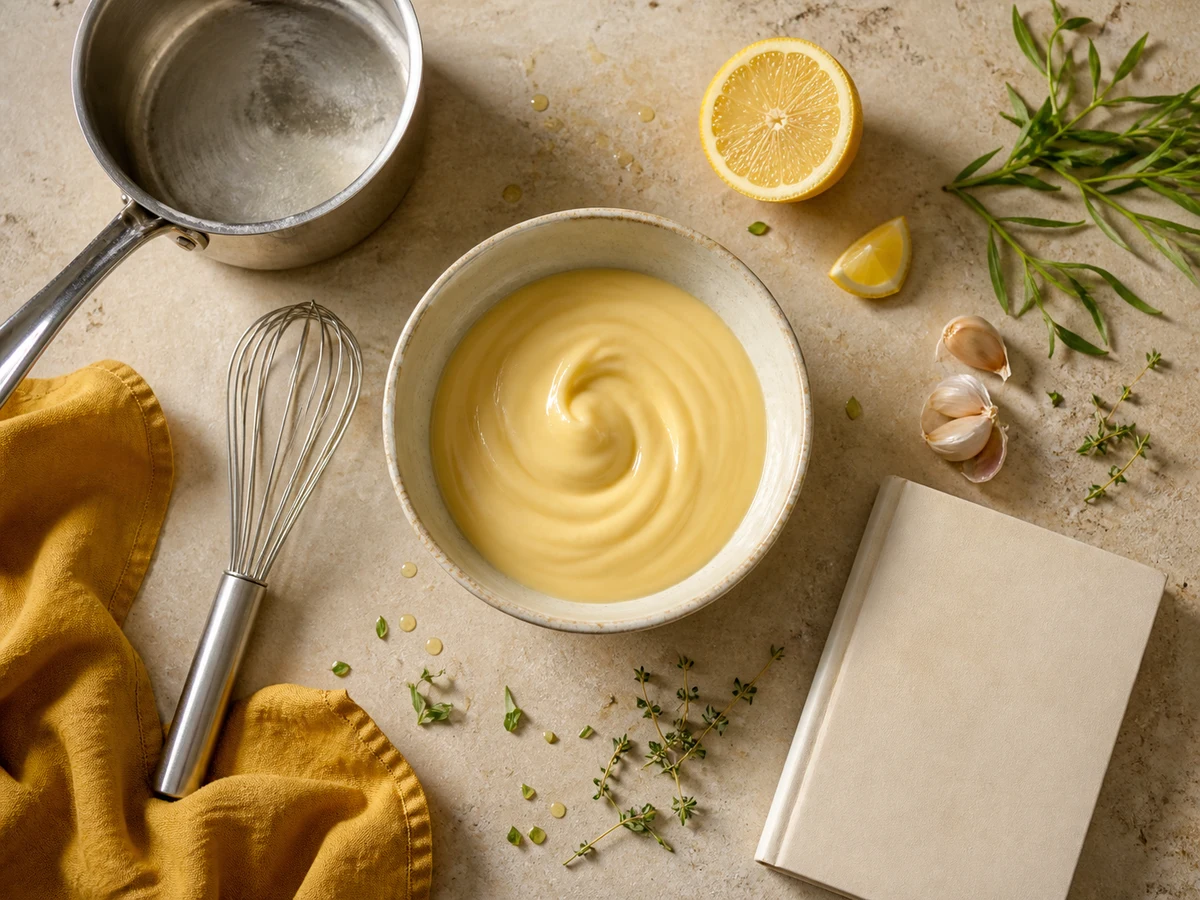
1. Ingredients and flavor profile
Hollandaise sauce is built from three core components: egg yolks, melted butter, and an acid — typically lemon juice, though a white wine or vinegar reduction is also traditional. Salt and either white pepper or cayenne pepper are standard seasonings.
The sauce is both a foam and an emulsion. Egg yolk proteins are gently cooked until they form a stable foam, and then molten butter is slowly whisked in to create a smooth, glossy emulsion. The result is a sauce that is simultaneously rich, velvety, and bright from the acid.
Texture and appearance
A properly made hollandaise is pale yellow, glossy, and pourable but thick enough to coat a spoon. Overheating causes the egg proteins to seize and the sauce to break into greasy, curdled clumps. Underheating leaves the sauce thin and unstable.
Making the emulsion
The classical technique uses a bain-marie (double boiler): egg yolks and the acid component are whisked over gentle indirect heat until thickened, then warm butter is incorporated in a slow, steady stream. Temperature control is the central challenge. The emulsion needs gentle, controlled heat; excess heat can coagulate the yolk and split the sauce. Follow the tested recipe rather than one universal threshold.
A blender method — combining the yolks and acid in a blender and streaming in hot butter — is a faster alternative common in American home kitchens, though it can be more prone to breaking.
Derivative sauces
Because hollandaise is a mother sauce, it serves as the base for several classic derivatives:
- Béarnaise — replaces lemon juice with a white wine and vinegar reduction; adds tarragon and shallots.
- Sauce maltaise — adds blood orange juice and zest for a tangy, slightly sweet variation.
- Sauce mousseline — folds in whipped cream for a lighter texture.
Tip. Add butter gradually and keep heat low. Rushing either step is the most common cause of a broken hollandaise.
2. Origins and culinary role
Hollandaise is part of the classical French sauce tradition and is commonly taught as a foundational or mother sauce. Modern culinary-school materials group it with béchamel, velouté, espagnole, and tomato because it can be served directly and used as a base for related sauces. That classification is well established as a teaching framework; a precise single-inventor story is not required to explain it.
The generated history previously attributed an exact 1903 codification to an encyclopedia-style site and repeated speculative accounts involving Huguenot migration and imported Dutch butter. Those sources do not provide a strong enough basis for the claims, so the page does not preserve them. Britannica notes a probable connection with Normandy and the earlier name sauce Isigny, but “probable” should remain qualified rather than converted into a certain origin.
The sauce’s modern culinary role is clearer. Egg yolk and butter form the core emulsion, with lemon juice, vinegar, or a reduction supplying acid depending on the recipe. Béarnaise is a familiar derivative that adds a seasoned wine-vinegar reduction and herbs; maltaise and mousseline are other named variations whose formulas can differ by culinary text.
Hollandaise is often served with eggs, asparagus, fish, shellfish, or other vegetables. These are familiar options rather than required pairings. Serve it sparingly so the main ingredient remains recognizable. Its butter and acid can contrast with mild foods, while a large amount can dominate their texture and flavor. Offer extra separately for diners who want more.
Use historical labels and pairings as context, not as proof that every current recipe is identical. For ingredients, technique, holding, and allergen questions, the exact tested recipe and product labels are more useful than an origin legend.
Tip. Hollandaise pairs best with mild, simply cooked proteins and vegetables where its buttery richness can take center stage.
3. Food safety, storage, and reheating
Hollandaise uses egg yolks that may remain raw or lightly cooked, so egg safety and time-and-temperature control matter. USDA and FoodSafety.gov recommend pasteurized eggs or egg products for recipes such as hollandaise that do not fully cook the egg. Pasteurization reduces risk but does not excuse poor handling, dirty utensils, or extended warm holding.
Follow a tested recipe and use a food thermometer where it specifies one. USDA’s 160°F endpoint for fully cooked egg dishes cannot simply be converted into a promise that every hollandaise method will preserve its emulsion at that temperature. When a recipe intentionally uses a lightly cooked yolk, pasteurized eggs are the conservative choice. People at higher risk of foodborne illness should follow current clinician and public-health advice.
Prepare only the amount needed and serve promptly. Do not leave a perishable egg sauce at room temperature for more than two hours, or one hour above 90°F. If leftovers have been handled safely, divide and refrigerate them promptly in a covered shallow container at 40°F or below. USDA’s general cooked-leftover period is three to four refrigerated days, but a tested hollandaise recipe may give a shorter quality or safety direction; follow the shorter exact instruction.
Reheating can split the emulsion. Gentle mixing or a double boiler may protect texture, but texture advice does not replace applicable food-safety guidance. Do not promise that a stored hollandaise will remain smooth or safe for a universal two-to-three-day period without reference to the actual recipe and handling.
Discard sauce with an unsafe or uncertain time-and-temperature history, mold, an off odor, or package contamination. Separation or curdling can be a quality change and does not by itself prove spoilage; when safety is uncertain, discard. Do not taste questionable sauce as a safety test.
Warning. Do not hold hollandaise at room temperature for more than 2 hours. Discard any sauce left in the danger zone beyond that limit.
Warning. Higher-risk individuals should use only pasteurized eggs. Consult a healthcare provider if uncertain about consuming lightly cooked egg products.
Sources
Primary and direct references used for current or safety-sensitive claims.
- Hollandaise sauce | Origins, Ingredients, Taste, & Uses | Britannica — Hollandaise sauce probably traces its origins to the northern French region of Normandy, where it was first called sauce Isigny.
- Egg Products and Food Safety | USDA Food Safety and Inspection Service — USDA recommends pasteurized egg products as a substitute in recipes such as hollandaise sauce that use raw eggs not fully cooked.
- Salmonella and Eggs | FoodSafety.gov — FoodSafety.gov recommends using pasteurized eggs to make foods containing raw or lightly cooked eggs, such as hollandaise sauce.
- Shell Eggs from Farm to Table | USDA Food Safety and Inspection Service — USDA advises cooking egg dishes that do not contain meat or poultry to a safe minimum internal temperature of 160 °F.
- What You Need to Know About Egg Safety | FDA — FDA advises storing eggs promptly in a clean refrigerator at a temperature of 40 °F or below.
- How to Make the Five Mother Sauces | Escoffier — Escoffier culinary instructors describe béchamel and hollandaise as foundational sauces, give their core ingredients, and present tested preparation techniques and common derivatives.
- Leftovers and Food Safety | USDA FSIS — USDA FSIS says hot food may be refrigerated directly in shallow containers, describes safe thawing and refreezing methods, and gives a general three-to-four-day refrigerated leftover window.
Guide FAQ
Short, self-contained answers to common technique questions.
What does hollandaise sauce taste like?
Hollandaise tastes rich and buttery with a bright, tangy edge from lemon juice or vinegar. The texture is smooth and velvety. It is not spicy, though white pepper or cayenne adds a mild background heat. The overall flavor is delicate rather than sharp.
What is the difference between hollandaise and béarnaise sauce?
Both are egg-yolk-and-butter emulsions, but béarnaise replaces lemon juice with a white wine and vinegar reduction and adds tarragon and shallots. Béarnaise has a more herbaceous, savory flavor, while hollandaise is simpler and more citrus-forward. Béarnaise is considered a derivative of hollandaise.
Is hollandaise sauce safe to eat?
It can be prepared more conservatively with pasteurized eggs and a tested method. Time, temperature, cleanliness, and prompt service still matter. People at higher risk should follow current clinician and public-health guidance.
How long does homemade hollandaise sauce last?
Do not use one universal two-to-three-day claim. Serve promptly, refrigerate safely handled leftovers in a covered shallow container, and follow the tested recipe’s shorter direction when it provides one. Discard if handling is uncertain.
Why does hollandaise sauce break, and can it be fixed?
Hollandaise breaks when the emulsion separates, usually from overheating, adding butter too quickly, or temperature shock. To fix a broken sauce, whisk a fresh egg yolk in a clean bowl over gentle heat, then slowly whisk the broken sauce into it. Not all broken sauces can be rescued; starting fresh is sometimes necessary.
Is hollandaise sauce gluten-free?
Traditional hollandaise — egg yolks, butter, lemon juice, and pepper — contains no gluten-containing ingredients. However, formulations vary, and packaged or restaurant versions may include additives or thickeners that contain gluten. Always check the label or ask about preparation when gluten sensitivity is a concern.