Sauce technique guide
What is béchamel sauce?
Béchamel is a milk-based white sauce thickened with a pale roux of flour and butter. It is a foundational French sauce used directly and as a base for preparations such as Mornay and Soubise.
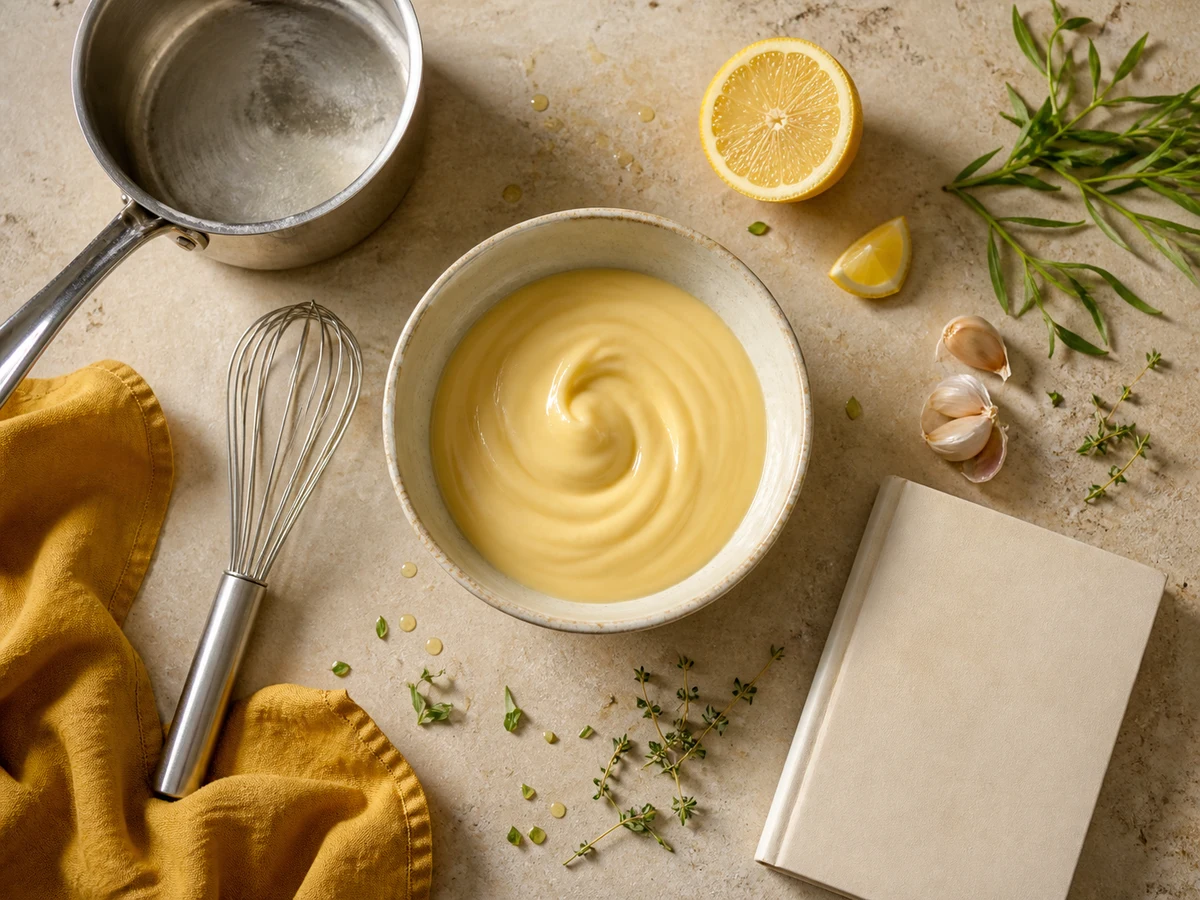
1. Definition and Core Ingredients
Béchamel combines milk with a pale roux, usually made from flour and butter. The roux disperses starch in fat before liquid is added, helping the sauce thicken smoothly. Escoffier culinary instructors demonstrate warming the milk, cooking the butter-and-flour mixture without browning it, and whisking in the liquid gradually. The exact quantities, pan, heat, and cooking time belong to the selected recipe.
Avoid presenting thin, medium, and thick béchamel with one universal tablespoon-per-cup chart. Flour strength, measurement method, desired finish, and later ingredients all change the result. A sauce for lasagna may be looser than one used to bind croquettes. If consistency matters, weigh ingredients or follow a tested formula and judge the finished sauce at its serving temperature.
Traditional versions usually use milk rather than cream, but recipes can vary. Salt, white or black pepper, nutmeg, onion, bay, cheese, and other seasonings are choices tied to the dish. Mornay is a familiar cheese-enriched derivative, and Soubise adds cooked onion. Those names describe culinary families, not a guarantee that every published formula uses identical cheeses or proportions.
Béchamel commonly appears in gratins, baked pasta, croque monsieur, vegetable dishes, and other recipes that need a mild sauce or binder. Its neutral base also makes it easy to season differently for each regional application. Treat those uses as examples rather than an exhaustive list.
The basic sauce contains milk and wheat when made with conventional ingredients. Dairy-free or gluten-free adaptations require a separate tested recipe because alternative milks and starches behave differently. For celiac disease or another allergy, inspect every exact ingredient and cross-contact statement; a generic substitution name is not proof of suitability.
Tip. Press plastic wrap directly onto the surface of finished béchamel to prevent a skin from forming as it cools.
Warning. Béchamel contains dairy and wheat gluten. It is not suitable for dairy-free or gluten-free diets without verified ingredient substitutions.
2. History and Culinary Role
Béchamel is taught as one of the foundational or “mother” sauces in classical French culinary practice. Modern culinary texts group it with velouté, espagnole, tomato, and hollandaise because each can anchor multiple derivative sauces. This classification is useful for learning technique, but it does not require a precise origin legend or a claim that one person invented the sauce.
Popular histories connect béchamel with Marie-Antoine Carême, Auguste Escoffier, François Pierre de La Varenne, Louis de Béchameil, and earlier Italian white sauces. The surviving story is more complicated than a single attribution, and the reviewed sources here do not establish the generated page’s earlier sixteenth-century transfer, 1651 “first recipe,” or naming account. Those disputed details are omitted rather than presented as fact.
The culinary role is clearer. A pale roux thickens milk into a sauce that can carry additional flavor without requiring a strongly flavored stock. Cheese can turn the base into a Mornay-style sauce; cooked onion can produce Soubise; other recipes use béchamel in baked pasta, gratins, sandwiches, vegetables, or fillings. Names and ingredients still vary across regions and teaching traditions, so follow the exact recipe being used.
Thinking in sauce families helps a cook diagnose changes. Adding cheese alters salt, fat, and melting behavior. Adding puréed onion changes water and sweetness. Changing the milk or starch affects viscosity and allergen status. Each derivative should be evaluated as its own formula rather than inheriting every property of the base.
Use the “mother sauce” label as a map of technique and related preparations, not as proof for a precise historical date. That distinction keeps the page useful without repeating an origin claim that the cited culinary sources do not independently verify.
Tip. Mornay sauce is béchamel with cheese melted in — the most common and accessible daughter sauce for home cooks.
3. Making, Using, and Storing Béchamel
Follow a tested recipe for preparation. A common sequence is to cook a pale roux, add warm milk gradually while whisking, and continue gentle cooking until the raw flour flavor is gone and the target texture is reached. Pan size, batch size, flour, heat, and later cheese or seasoning affect the time, so fixed one-to-two- or five-to-eight-minute rules are only recipe-specific examples.
If lumps form, remove the pan from aggressive heat and whisk. A compatible amount of warm milk may loosen a sauce that is too thick, and straining may improve a stubborn batch. A scorched flavor cannot be whisked away; transfer any unscorched portion without scraping the pan or start over. Add cheese according to the recipe and control heat so texture is not sacrificed.
For storage, divide hot sauce into shallow containers and refrigerate promptly; hot food may go directly into the refrigerator. An ice-water bath can speed cooling for a large batch. Keep the refrigerator at 40°F or below. USDA gives three to four refrigerated days as a general period for properly handled cooked leftovers, but follow any shorter exact recipe or ingredient direction.
Freezing can reduce béchamel quality because cream-style emulsions may separate. Separation or curdling can be a quality change and does not by itself prove spoilage; when safety is uncertain, discard. Use freezer packaging intended for food and the exact temperature, label the portion, and use recipe-specific quality guidance rather than one universal three-month promise.
Sauce thawed in the refrigerator may be refrozen without cooking, although quality may decline. Sauce thawed in cold water or the microwave should be reheated to 165°F before refreezing. Discard for mold, an off odor, package damage, or an unsafe or uncertain handling history.
Warning. Discard béchamel left at room temperature for more than 2 hours. Per USDA guidance, its dairy base supports rapid bacterial growth in the temperature danger zone.
Tip. Reheat refrigerated béchamel over low heat, whisking in a splash of warm milk to restore its original consistency.
Sources
Primary and direct references used for current or safety-sensitive claims.
- Leftovers and Food Safety | Food Safety and Inspection Service — Cooked perishable foods must be refrigerated within 2 hours of cooking; discard any portion left at room temperature longer than that.
- Are You Storing Food Safely? | FDA — The FDA recommends keeping the refrigerator temperature at or below 40°F (4°C).
- Refrigerator Thermometers - Cold Facts about Food Safety | FDA — Refrigerate or freeze perishables within 2 hours of cooking; bring sauces, soups, and gravy to a boil when reheating.
- How to Make the Five Mother Sauces | Escoffier — Escoffier culinary instructors describe béchamel and hollandaise as foundational sauces, give their core ingredients, and present tested preparation techniques and common derivatives.
- Freezing and Food Safety | USDA FSIS — USDA FSIS explains that freezing preserves safety while quality can decline, and that refrigerator-thawed food may be refrozen without cooking although quality may suffer.
Guide FAQ
Short, self-contained answers to common technique questions.
What is the difference between béchamel and white sauce?
The terms often overlap, but a regional “white sauce” recipe may use different proportions or seasonings. Béchamel specifically refers to the milk-and-pale-roux sauce family; follow the exact recipe rather than assuming every label is identical.
What is the difference between béchamel and Mornay sauce?
Mornay is a cheese-enriched sauce built from béchamel. Cheese choices and proportions vary by recipe, so Gruyère, Parmesan, Cheddar, or another cheese should be treated as formula-specific rather than mandatory.
Does béchamel contain cream?
Many classical béchamel recipes use milk, butter, and flour without cream. Other recipes add cream or use alternatives. Check the exact formula instead of treating the name as a complete ingredient list.
How do you fix lumpy béchamel?
Remove the pan from aggressive heat and whisk. Add a small amount of compatible warm liquid if the sauce is too thick, or strain persistent lumps. Scorched sauce usually requires transferring the unburned portion or starting again.
How long does béchamel last in the refrigerator?
USDA gives three to four refrigerated days for properly handled cooked leftovers; follow any shorter exact recipe direction. Discard for unsafe handling, mold, an off odor, or package damage. Separation or curdling can be a quality change and does not by itself prove spoilage; when safety is uncertain, discard.
Can béchamel be made gluten-free?
It can be adapted with a tested gluten-free recipe, but starch products behave differently. Verify every ingredient and cross-contact statement for the person’s needs; the word “cornstarch” or “flour blend” alone does not prove suitability.