Sauce technique guide
How to store homemade sauce
Store homemade sauce according to its complete recipe and handling history. Refrigerate hot sauce promptly in shallow covered containers, label each portion, and use exact recipe or manufacturer guidance instead of one shelf-life promise for every sauce.
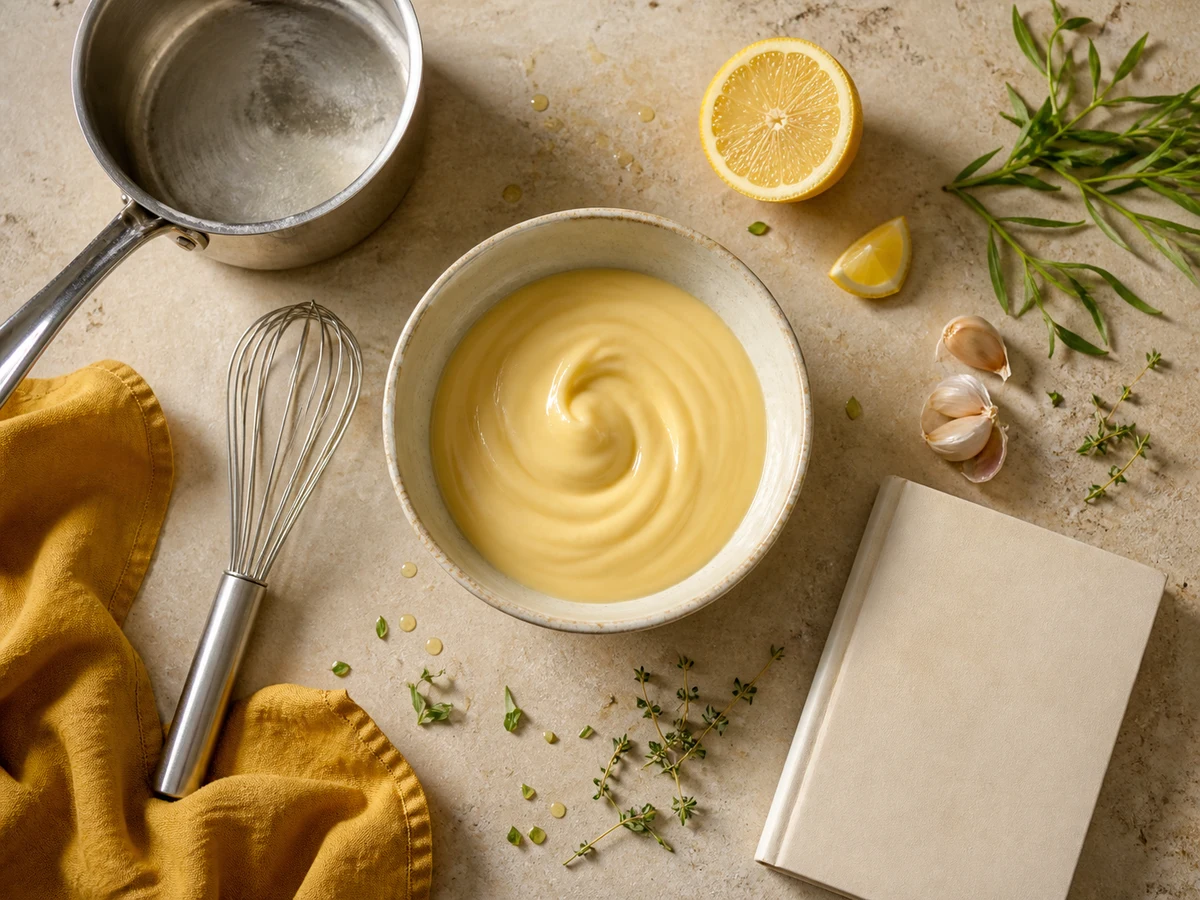
1. Refrigerate sauce promptly and label it
Start with the complete sauce, not a category name. Meat, seafood, dairy, egg, fresh herbs, cooked vegetables, and packaged ingredients can each introduce a more specific storage direction. Keep the recipe and any original labels available. When a tested recipe, ingredient label, or public-health instruction gives a shorter limit than general leftover guidance, follow the shorter direction.
Divide hot sauce into shallow containers and refrigerate promptly; hot food may go directly into the refrigerator. An ice-water bath can speed cooling for large batches. Do not leave a full stockpot on the counter until it reaches room temperature. Cover or seal portions, keep the refrigerator at 40°F or below, and avoid overfilling the appliance so cold air can circulate.
USDA gives three to four refrigerated days as a general window for properly handled cooked leftovers. That is not proof that every uncooked dressing, egg sauce, seafood sauce, retail product, or specialized recipe has the same limit. Record the preparation date and the recipe or product identity on each container. Store raw ingredients separately and prevent their juices from contacting ready-to-eat sauce.
Choose a clean container intended for food storage and the refrigerator. Refrigerating food in an opened can is generally permitted, but transferring it to glass or food-grade plastic can better preserve flavor and quality. Use a clean utensil for serving and return the covered container promptly rather than leaving the entire batch at the table.
Discard sauce whose time-and-temperature history is unsafe or unknown. A date label helps manage storage, but it cannot repair mishandling. Do not taste food to decide whether an uncertain storage history was safe.
Warning. Hot sauce may go directly into shallow containers in the refrigerator; do not wait for room temperature.
2. Freeze by recipe, package, and quality needs
Freezing can extend storage, but it does not create one best-quality period for every sauce. USDA explains that continuously frozen food can remain safe while flavor, moisture, color, and texture decline. Recipe composition, package, freezer conditions, air exposure, and the sauce’s quality before freezing all affect the thawed result.
Use a container or bag specifically labeled for food and freezer storage. Follow its temperature, fill, and headspace instructions. NCHFP notes that freezer packaging should resist moisture vapor, remain durable at low temperature, seal well, and protect food from odors. Glass must be designed for freezing; an ordinary retail jar may crack. Remove excess air from freezer bags without forcing sauce into the closure.
Portion the sauce in amounts likely to be used at one time. Label each package with the sauce, ingredients relevant to allergies, portion size, and freeze date. Freeze only food with a safe handling history; freezing does not destroy every hazard or reset time already spent under unsafe conditions.
Texture is recipe-specific. Cream and other emulsified sauces may separate or look grainy, starch-thickened sauces may change consistency, and herb sauces may lose fresh color or aroma. Separation or curdling can be a quality change and does not by itself prove spoilage; when safety is uncertain, discard. Freeze a small test portion when quality is important.
For a retail ingredient or prepared sauce, follow the exact manufacturer’s freezing guidance. For homemade food, use a tested recipe’s guidance when available. UC ANR describes a four-to-six-month quality range for many prepared foods, but that range is not a category-wide guarantee for every homemade sauce.
Tip. Freeze a small test portion before committing a full batch of a delicate emulsion.
3. Thaw, reheat, and evaluate leftovers safely
Thaw sauce in the refrigerator when time allows. A leak-proof package may also be thawed in cold water, and a microwave-safe container may be used for microwave thawing. Food thawed by cold water or microwave should move directly into cooking or reheating. Do not thaw a perishable sauce on the counter.
Reheat leftovers throughout to 165°F as measured with a food thermometer. USDA also directs that sauces, soups, and gravies reheated on the stovetop be brought to a rolling boil. Stir while reheating and check more than one location, especially after microwave heating, because cold spots can remain. Texture advice such as gentle heat for cream sauce does not replace the safety endpoint.
Sauce thawed in the refrigerator may be refrozen without cooking, although quality may decline. Sauce thawed in cold water or the microwave should be reheated to 165°F before refreezing. If reheated sauce remains, refrigerate it promptly in a shallow container. Safely handled leftovers may be refrigerated again; each cooling and reheating cycle still reduces quality. Reheat leftovers to 165°F each time.
Discard sauce with mold, an off odor, a damaged or leaking package, or an unsafe or uncertain handling history. Unusual gas production can also be a warning in a sealed product. Color or texture can change for quality reasons, so neither appearance nor smell alone proves safety. Separation or curdling can be a quality change and does not by itself prove spoilage; when safety is uncertain, discard.
Keep the label with the portion through thawing and any refreezing. When a product is recalled or a package direction changes, the exact identity matters more than the broad sauce category.
Warning. Cold-water- or microwave-thawed sauce should be reheated to 165°F before refreezing.
Sources
Primary and direct references used for current or safety-sensitive claims.
- Leftovers and Food Safety | USDA FSIS — USDA FSIS says hot food may be refrigerated directly in shallow containers, describes safe thawing and refreezing methods, and gives a general three-to-four-day refrigerated leftover window.
- Freezing and Food Safety | USDA FSIS — USDA FSIS explains that freezing preserves safety while quality can decline, and that refrigerator-thawed food may be refrozen without cooking although quality may suffer.
- Are You Storing Food Safely? | FDA — FDA advises prompt refrigeration, covered storage, label checks, and discarding food when safety is uncertain.
- Shelf-Stable Food Safety | USDA FSIS — USDA FSIS says unused canned food may be refrigerated in the can, while transfer to glass or plastic can better preserve flavor and quality.
Guide FAQ
Short, self-contained answers to common technique questions.
Must homemade sauce cool completely before refrigeration?
No. Divide hot sauce into shallow containers and refrigerate promptly; hot food may go directly into the refrigerator. An ice-water bath can speed cooling for a large batch.
How long does every homemade sauce last in the refrigerator?
There is no single limit for every sauce. USDA gives three to four days for properly handled cooked leftovers, but the exact recipe, ingredient label, or a shorter product-specific direction controls.
Can homemade sauce be frozen for six months?
Some prepared foods have a four-to-six-month quality range, but that is not universal. Follow the exact recipe or manufacturer guidance and judge safety separately from texture, flavor, and freezer burn.
Can sauce stay in an opened can?
Refrigerating food in an opened can is generally permitted, but transferring it to glass or food-grade plastic can better preserve flavor and quality.
Does separation mean frozen sauce spoiled?
Not by itself. Separation or curdling can be a quality change. Discard for an unsafe or uncertain handling history, mold, an off odor, or package damage.
Can reheated sauce be refrigerated again?
Yes, when it was handled safely. Refrigerate it promptly in a shallow container and reheat it to 165°F each time. Repeated cycles can still reduce quality.